D

Open-source alternative to dmarcian

DMARC Report Viewer is a free, open-source dmarcian alternative that turns the DMARC and SMTP TLS reports mailbox providers send you into charts of who sends email as your domain and whether it passes SPF and DKIM. dmarcian is a paid subscription that also guides your DMARC rollout and sends alerts; DMARC Report Viewer only shows your reports, but they stay in your own mailbox and server.

Free app Code: Open source Import from dmarcian: No Some setup

Why look for an alternative to dmarcian?

dmarcian is a hosted DMARC service: it collects the reports mailbox providers send about mail from your domain, shows which services send as you, and guides you towards a stricter DMARC policy.

Small businesses look for an alternative because dmarcian is a paid subscription, and many only need to see who sends email as their domain before they tighten their policy. Some also prefer that their reports don't go to another company. A self-hosted DMARC Report Viewer reads the reports straight from your own mailbox and shows them as charts and tables, for no fee.

How DMARC Report Viewer compares

Read your DMARC reports and see who sends email as your domain.

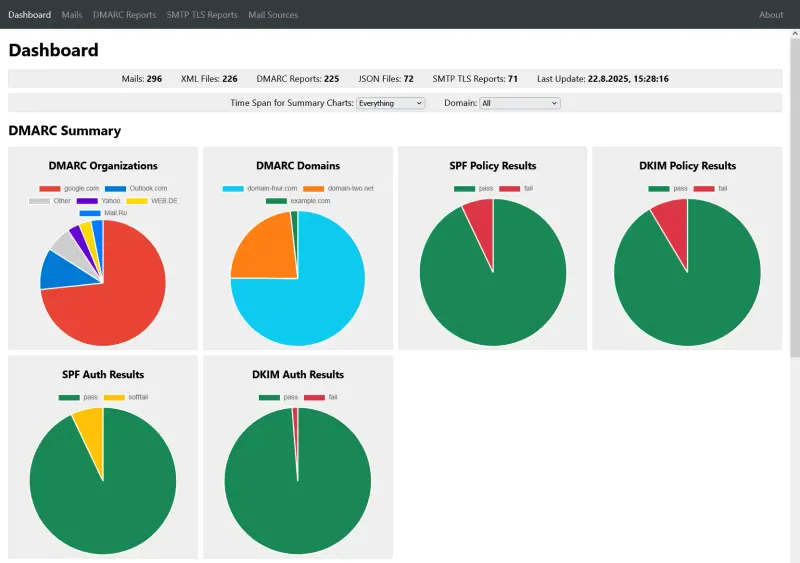
Reads the DMARC aggregate and SMTP TLS reports from your own mailbox and shows who sends email as your domain, how much, and whether each source passed SPF and DKIM, with filters for problem reports and a lookup for each sending address. It does not guide your DMARC rollout, change DNS records or email you alerts, and it has one shared login.

What you gain
  • Your reports stay in your own mailbox and on your server
  • Free for any number of domains and reports
  • Covers DMARC and SMTP TLS reports in one place
What is different
  • It shows your reports but does not guide you through a DMARC rollout
  • No email alerts; a webhook can tell another app when new reports arrive
  • One shared login, not separate user accounts
Some setup Open source

Moving from dmarcian

Create a mailbox for reports, or use an existing one, and add it to your DMARC DNS record's rua= address, next to or instead of dmarcian's. Enter that mailbox's IMAP server, username and password when you install DMARC Report Viewer; it checks the mailbox every 30 minutes. Mailbox providers send reports about once a day, so the charts fill in over the following days. Past reports kept by dmarcian do not move across.

Questions

What is the best open-source alternative to dmarcian?

DMARC Report Viewer is the free, open-source alternative to dmarcian for reading DMARC reports in the catalogue today. Reads the DMARC aggregate and SMTP TLS reports from your own mailbox and shows who sends email as your domain, how much, and whether each source passed SPF and DKIM, with filters for problem reports and a lookup for each sending address. It does not guide your DMARC rollout, change DNS records or email you alerts, and it has one shared login.

Does DMARC Report Viewer keep my reports?

Your mailbox does. The app has no database: it reads every report from the mailbox each time it checks, so your history is whatever you keep in that mailbox.

Does it work with Microsoft 365?

Not directly. It signs in to the mailbox over IMAP with a password, which Microsoft 365 does not allow; an IMAP proxy such as DavMail is the workaround.

Will it tell me when something fails?

Not by email. It can call a webhook when new reports arrive, and the dashboard flags sources that fail SPF or DKIM.

Is DMARC Report Viewer really free compared with dmarcian?

Yes, DMARC Report Viewer is free. To run them you need Cloudgate and a server. Use hosted Cloudgate, which can also provide the server, or install Cloudgate on a server of your own for free. Cloudgate's plans and prices are at cloudgate.octabyte.io/pricing. One server can run several apps.

Do I need a developer to replace dmarcian?

No. Cloudgate installs DMARC Report Viewer on your server and gives it a secure web address, and you use it in your browser instead of dmarcian.