
Open-source alternatives to Retool

Appsmith is a free, open-source Retool alternative for building admin panels, dashboards and other internal tools on your own databases and APIs, with drag-and-drop widgets and JavaScript. Retool charges per builder and per internal user, and offers self-hosting only on its Enterprise plan; Appsmith’s self-hosted Community Edition has no per-user price, though features such as SSO and audit logs are paid extras.

3 alternatives Free apps Our pick: Appsmith

At a glance

App Good for Code Ease of use
Appsmith Developers and technical teams building admin panels, dashboards and internal tools on their own databases and APIs Code Open source Some setup
Lowcoder Small teams with a semi-technical builder making internal tools, plus public forms or simple customer portals, on their own databases and APIs Code Open source Some setup
ToolJet Operations and support teams with someone semi-technical, building admin panels and dashboards on their own data or a built-in database Code Open source Some setup

Why look for an alternative to Retool?

Retool is a hosted platform for building internal tools: admin panels, dashboards and forms that read and write your company's databases and APIs, put together from ready-made components and JavaScript.

People look for an alternative because Retool charges per person. When we checked its pricing page in November 2026, the free plan covered up to 5 users; the Team plan cost $10 per builder and $5 per internal user a month, billed yearly, and the Business plan $50 and $15. Self-hosting Retool is offered only on the Enterprise plan. Appsmith, ToolJet and Lowcoder work the same way, with components, queries and code, and their Community Editions run on your own server with no per-user price.

The alternatives, compared

Appsmith

Our pick

Build internal tools and admin panels on your own databases.

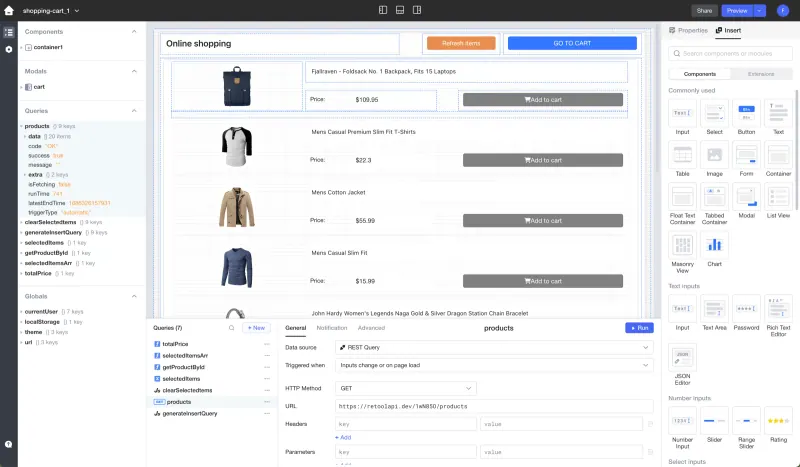
The closest match: drag widgets such as tables, forms and charts onto a canvas, connect them to PostgreSQL, MySQL, MongoDB, REST and GraphQL APIs and more, and add logic in JavaScript, with Git version control. Retool is more polished and has more built in; in Appsmith's free Community Edition, workflows, audit logs, custom roles and SSO are paid extras.

What you gain
  • Self-hosted with no per-user fee
  • Your data and your database passwords stay on your own server
  • Open source under the Apache-2.0 licence
What is different
  • Workflows, audit logs, custom roles, single sign-on with SAML or OIDC, and connectors such as Salesforce and Slack are paid plans only
  • Retool apps don't import; you rebuild them
  • You need SQL and JavaScript for real apps; it's not built for non-technical staff
Some setup Open source

Build internal tools and public web apps on your own data.

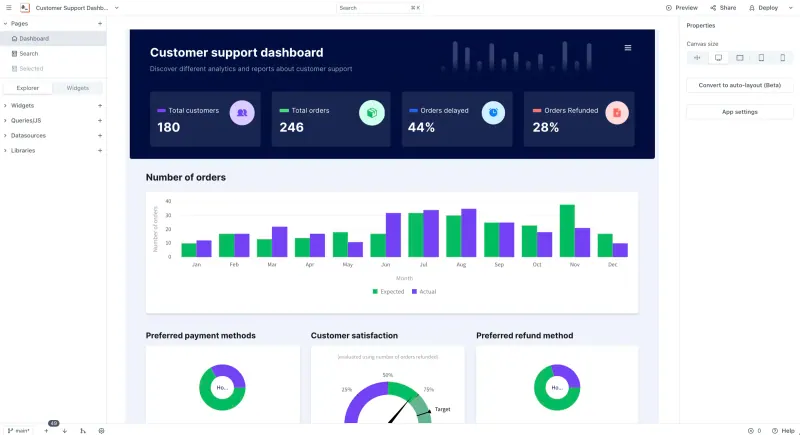
Works the same way, components, SQL queries and JavaScript on your own databases and APIs, and its free Community Edition can also make an app public, so people use it without an account, and embed it in a website. Audit logs, separate environments and custom branding are paid Enterprise extras, it has no built-in database, and it has fewer of Retool's ready-made integrations.

What you gain
  • Self-hosted with no per-user fee
  • Free apps can be public, for forms and simple customer portals
  • Your data and database passwords stay on your own server
What is different
  • Audit logs, separate test and live environments, usage statistics, custom branding and the AI app builder are paid Enterprise extras
  • There is no built-in database; apps work on a database, API or Google Sheet you already have
  • Retool, Power Apps and Softr apps don't import; you rebuild them
Some setup Open source

Build admin panels and internal tools on your own data and server.

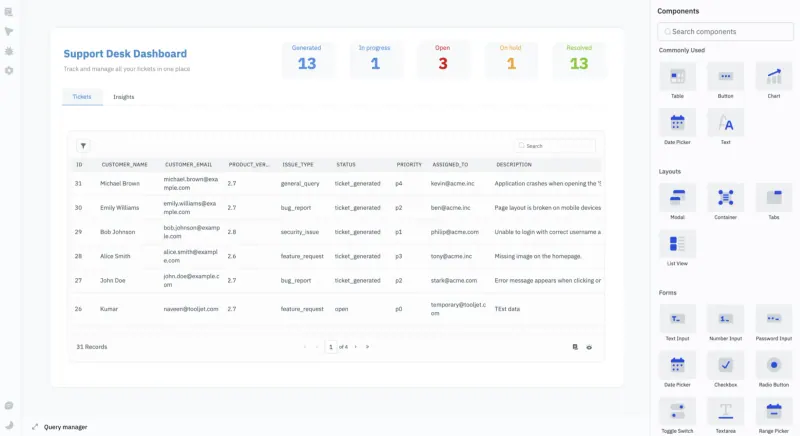
Works the same way, components, queries and code on your own data, and adds a built-in database for teams that have none, plus Python as well as JavaScript. Its free Community Edition has no seat limit, but leaves out SSO of any kind, audit logs, workflows, Git sync and public apps, and it runs on x86 servers only.

What you gain
  • Self-hosted with no limit on users, builders or apps
  • Your data and database passwords stay on your own server
  • Open source under the AGPL-3.0 licence
What is different
  • AI app building, workflows, single sign-on, audit logs, Git sync and real-time co-editing are paid editions only
  • Apps can't be made public, so it isn't for customer portals
  • Retool, Glide and Softr apps don't import; you rebuild them
Some setup Open source

Moving from Retool

There is no Retool importer, so you rebuild each app in Appsmith. Start with the tool your team uses most: connect the same databases and APIs as datasources, recreate the queries, then lay out the widgets and move your JavaScript across, adjusting it where the two products differ. Appsmith's templates give you a starting point for common screens such as an admin panel. Invite your team to the workspace, and keep the Retool app running until the new one has been checked. Moving to ToolJet works the same way: connect the data sources, recreate the queries in SQL, JavaScript or Python, rebuild the screens, and invite colleagues as end users, who see only the released apps you give them. In Lowcoder, connect the same data sources, recreate the queries, rebuild each screen from its components, then invite teammates from the workspace's Members settings; sign-up stays open, and everyone who signs up on their own gets a separate workspace.

Questions

What is the best open-source alternative to Retool?

Start with Appsmith. All 3 are free and open source.

Is Appsmith really open source?

Yes. Appsmith's Community Edition, the one this template installs, is open source under the Apache 2.0 licence. Appsmith also sells a commercial edition with extra features.

Which Retool features are missing from Appsmith's Community Edition?

Workflows, audit logs, custom roles, SSO with OIDC or SAML, environments and removing Appsmith's branding are in Appsmith's paid plans, not in the Community Edition.

Should I choose Appsmith, ToolJet or Lowcoder?

Choose Appsmith if you want Git version control in the free edition and an Apache 2.0 licence. Choose ToolJet if your team has no database yet and wants its built-in tables, or prefers writing logic in Python; its free edition has no Git sync or SSO. Choose Lowcoder if some of your apps are for customers or the public, since its free edition can publish apps without a login and embed them in your website.

How big a server does Appsmith need?

A fairly large one. Appsmith runs as one large container that is slow to start the first time. This template puts it on a large server with 4 GB of memory, and Appsmith's Docker guide recommends 8 GB on the host.

Are these Retool alternatives really free?

Yes, Appsmith, Lowcoder and ToolJet are free. To run them you need Cloudgate and a server. Use hosted Cloudgate, which can also provide the server, or install Cloudgate on a server of your own for free. Cloudgate's plans and prices are at cloudgate.octabyte.io/pricing. One server can run several apps.

Do I need a developer to replace Retool?

No. Cloudgate installs the app you choose on your server and gives it a secure web address, and you use it in your browser instead of Retool.