

S

Open-source alternatives to ServiceNow

GLPI is a free, open-source ServiceNow alternative for IT service management: incidents, requests, problems and changes, with a CMDB and an inventory of every device in the same tool. ServiceNow is an enterprise platform sold by quote; GLPI covers the ITIL core for small and mid-sized IT teams with no per-agent fee, though it has nothing like ServiceNow’s range of workflows and integrations.

3 alternatives Free apps Our pick: GLPI

At a glance

App Good for Code Import from ServiceNow Ease of use
GLPI Internal IT teams that want tickets and an inventory of every computer in one tool Code Open source Import from ServiceNow No Some setup
iTop IT teams that want tickets linked to a CMDB of their services, servers and devices Code Open source Import from ServiceNow Partly Some setup
OTOBO IT and service desks that want OTRS-style queues, SLAs and processes with no fee per agent Code Open source Import from ServiceNow No Some setup

Why look for an alternative to ServiceNow?

ServiceNow is an enterprise platform for IT service management and other business workflows, with incident, problem and change management, a CMDB, a service portal, automation and AI features.

People look for an alternative because ServiceNow is built and priced for large organisations: it publishes no price list, and plans are agreed with its sales team. Smaller IT teams often need the ITIL basics, a help desk and an inventory, without an enterprise contract. GLPI covers those on your own server with no per-agent fee; OTOBO does the same with a stronger focus on ticket queues and processes, and iTop with a CMDB and impact analysis at its centre.

The alternatives, compared

GLPI

Our pick

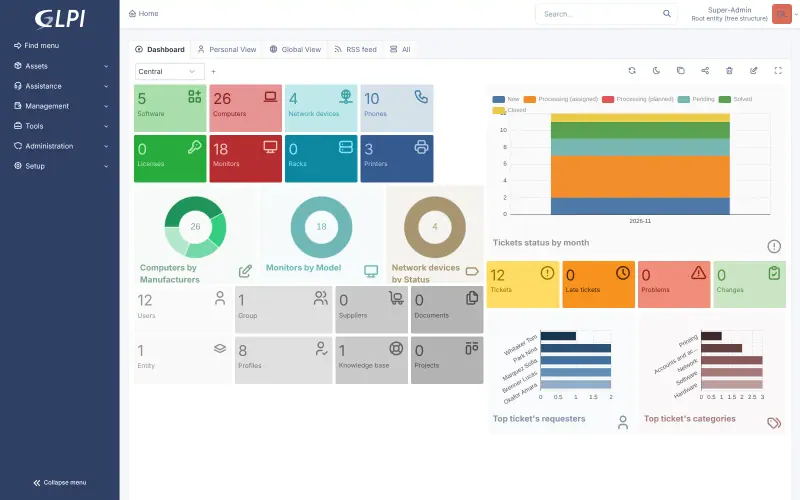
A self-hosted IT service desk with an inventory of every device.

Covers the ITIL core: incidents and requests with response-time targets, problems and changes, a service catalogue and self-service portal, a knowledge base, and a CMDB filled by automatic inventory through the GLPI Agent. It is built for small and mid-sized IT teams, with nothing like ServiceNow's workflow engine, AI features or range of integrations, and its interface is dense.

What you gain
  • No fee per technician and no paid packs for tracking more assets
  • The help desk and a full inventory of your equipment in one tool
  • Tickets, users and asset records stay on your own server
What is different
  • It takes more setup, such as categories, profiles and notifications, before the team starts
  • The screens are dense and use ITIL words such as incident, problem and change
  • There is no importer from ServiceNow, Freshservice or Jira Service Management
Some setup Open source

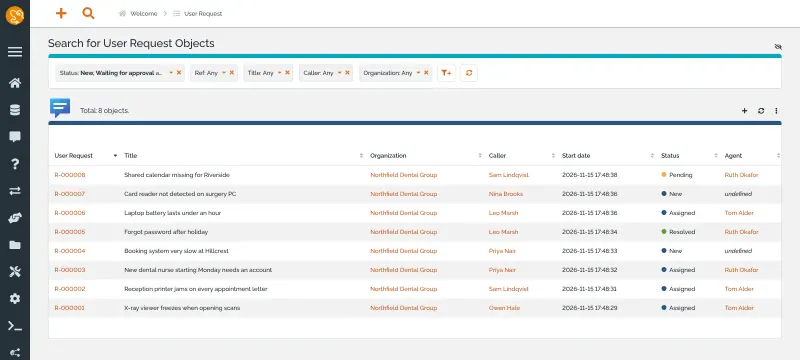
A self-hosted IT help desk linked to a CMDB of everything you run.

Built around its CMDB: servers, computers, applications and the business services that depend on them, with a graph of what a failure affects, plus requests and incidents, problems, changes, service contracts and SLAs, following ITIL. It has nothing like ServiceNow's platform, automation or AI, takes real setup, and needs a free extension for email-to-ticket.

What you gain
  • No subscription and no fee per agent
  • Tickets, contracts and your CMDB stay on your own server
  • Each ticket shows the servers, PCs and services it affects
What is different
  • It takes more setup, such as organisations, teams, services and contracts, before tickets flow well
  • The screens are dense and use ITIL words such as incident, problem and change
  • Turning emails into tickets needs the free Mail to ticket extension, which this template does not include
Some setup Open source

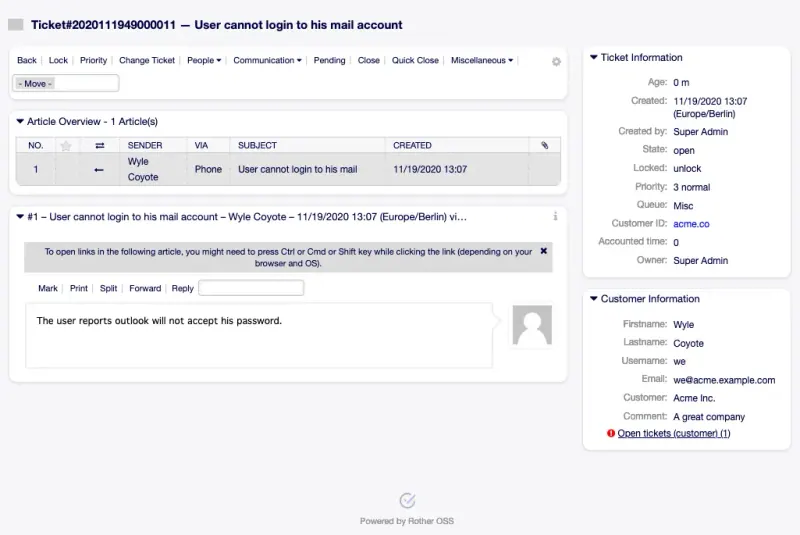
A self-hosted help desk and IT service desk that grew out of OTRS.

Covers the ITIL core with its free ITSM add-on: incidents, problems and changes, a CMDB of configuration items, a service catalogue with SLAs, a graphical process editor, automations and a customer portal. It is far smaller than ServiceNow, does not discover devices on its own, and needs a large server: 8 GB of memory for production.

Some setup Open source

Moving from ServiceNow

There is no ServiceNow importer. Set up your entities, profiles, ticket categories and SLAs in GLPI first, connect LDAP or Active Directory for your users, and install the GLPI Agent on your computers so they appear in the inventory on their own. Add a mailbox so people can open tickets by email. Finish open tickets in ServiceNow while new ones start in GLPI, and keep an export of your ServiceNow history. OTOBO has no ServiceNow importer either: install its free ITSM add-on, set up queues, services, SLAs and agents, add your configuration items to the CMDB, and connect your support mailbox. With iTop, set up your organisations, teams, services, contracts and SLAs first, then bring in people, devices and other records from CSV files exported from ServiceNow, since iTop's CSV import loads any kind of record. Add the free Mail to ticket extension if people open tickets by email, and give staff the address of iTop's user portal.

Questions

What is the best open-source alternative to ServiceNow?

Start with GLPI. All 3 are free and open source.

Should I choose GLPI or OTOBO?

Choose GLPI if you want an inventory that fills itself from your devices alongside the service desk. Choose OTOBO if your work runs on ticket queues, SLAs and multi-step processes, as in OTRS, and you can give it a large server.

What does GLPI charge for?

Only extras. GLPI itself, with the service desk, inventory, CMDB and portal, is free under the GPL. Its maker, Teclib', sells GLPI Network subscriptions for support and extra plugins, such as GLPI AI and an advanced dashboard, and a hosted GLPI Cloud.

How does GLPI find our computers?

Through the GLPI Agent, a separate program you install on Windows, macOS, Linux and Android devices. It reports each device's hardware and software to GLPI.

Should I choose GLPI or iTop?

Choose GLPI if you want devices found and inventoried automatically by its agent. Choose iTop if your tickets should be tied to a CMDB of services, servers and applications, with impact analysis and service contracts, which also suits IT service providers.

Are these ServiceNow alternatives really free?

Yes, GLPI, iTop and OTOBO are free. To run them you need Cloudgate and a server. Use hosted Cloudgate, which can also provide the server, or install Cloudgate on a server of your own for free. Cloudgate's plans and prices are at cloudgate.octabyte.io/pricing. One server can run several apps.

Do I need a developer to replace ServiceNow?

No. Cloudgate installs the app you choose on your server and gives it a secure web address, and you use it in your browser instead of ServiceNow.