
Elmo
AI visibility tracking for your brand and competitors.
No server needed to start: Cloudgate can provide one. What happens when you click Deploy




What is Elmo?
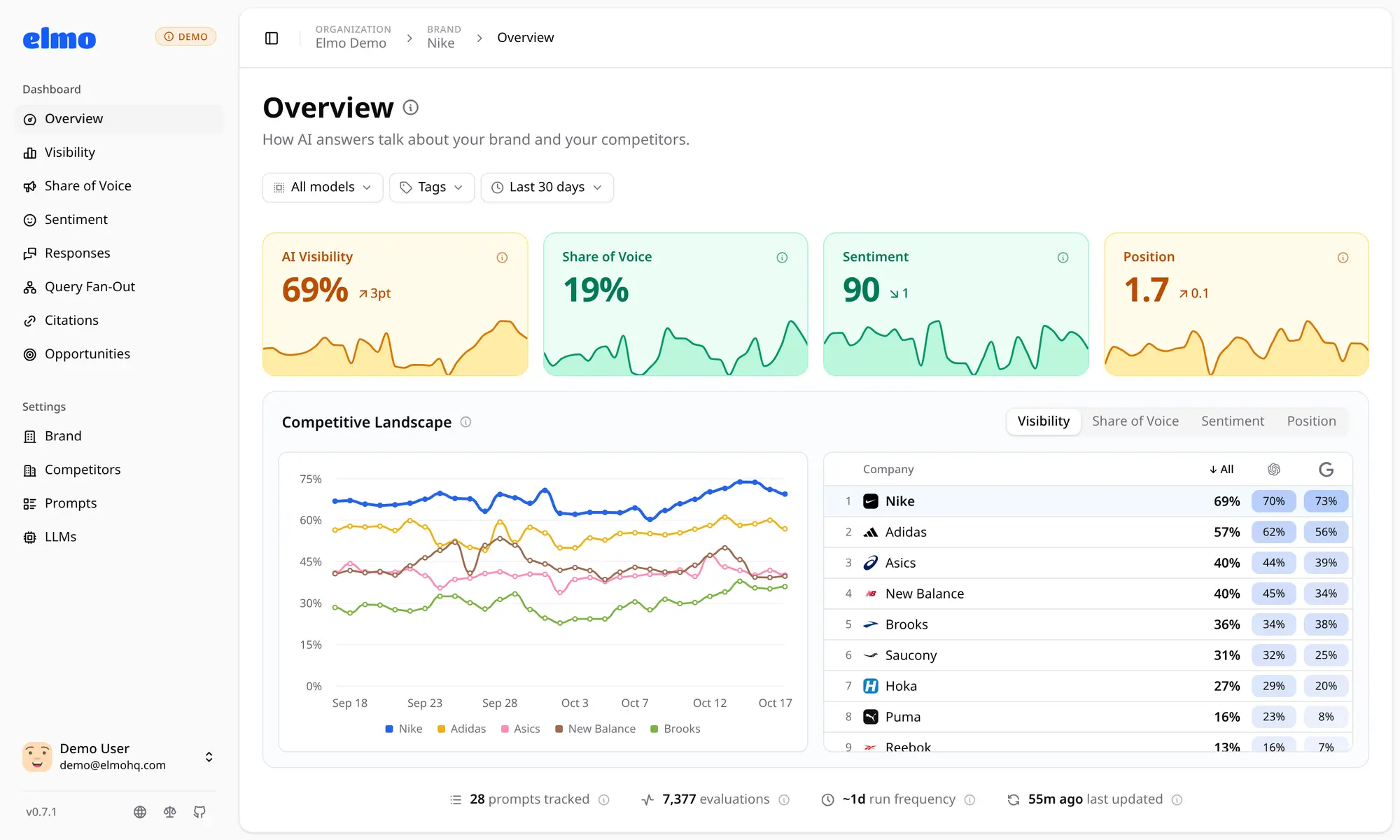
Elmo is a self-hosted AI visibility tracker: see how ChatGPT, Gemini, Claude and Google's AI answers mention, rank and cite your brand against competitors.
Elmo is an open-source, self-hosted AI visibility tracker that shows how ChatGPT, Google's AI answers, Gemini, Claude and Perplexity mention, describe and cite your brand, as a free alternative to Profound, Peec AI and Otterly.AI. This kind of work is often called answer engine optimization (AEO) or generative engine optimization (GEO).
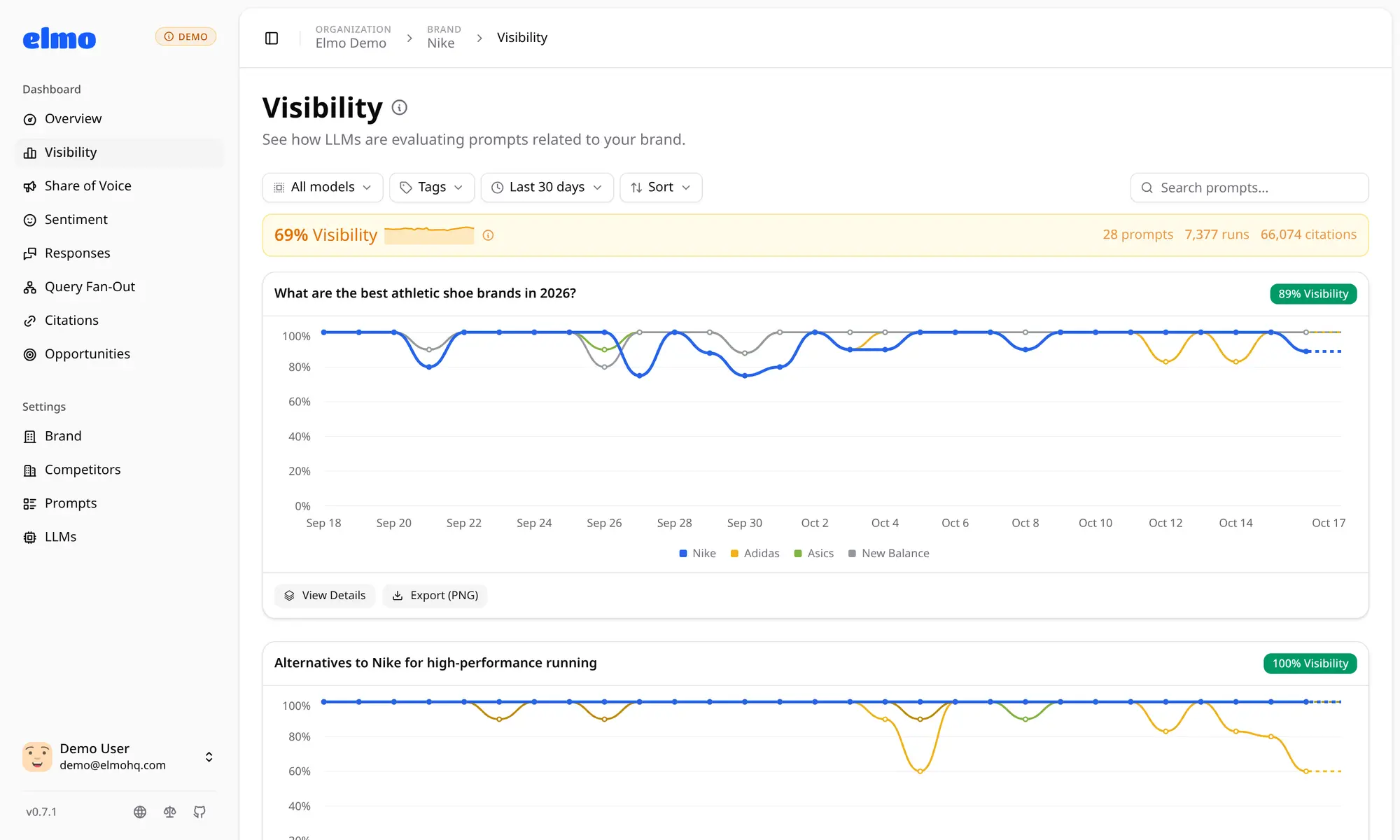
You list the questions your buyers ask AI, and your competitors. Elmo asks each AI those questions several times a day, keeps every answer, and shows how often you are named, where you rank, whether the answer is positive, and which websites the AI relied on. An Opportunities report then suggests what to publish or pitch next. A small running-shoe shop, for example, could track "best shoes for flat feet" and see that answers keep citing two review sites that never mention it, and pitch those sites first.
Elmo works through AI providers you sign up for, such as OpenRouter, plus a scraping service if you want to see the real ChatGPT and Google AI Mode apps; each check is billed by them. It has an API and connects to AI assistants for reading your data. There is no phone app.
Cloudgate installs Elmo on a server Cloudgate provides or one you connect, with its database, and gives it a secure web address.
What you can do with Elmo
- See how often AI mentions you Track, for every question your buyers ask, how often ChatGPT, Gemini, Claude, Perplexity and Google's AI answers name your brand, day by day.
- Compare yourself with competitors A share-of-voice leaderboard shows which companies AI recommends instead of you and how that changes over time.
- Know what AI says about you Each answer is marked positive, neutral, mixed or negative for you and each competitor, with your rank and the exact passage behind it.
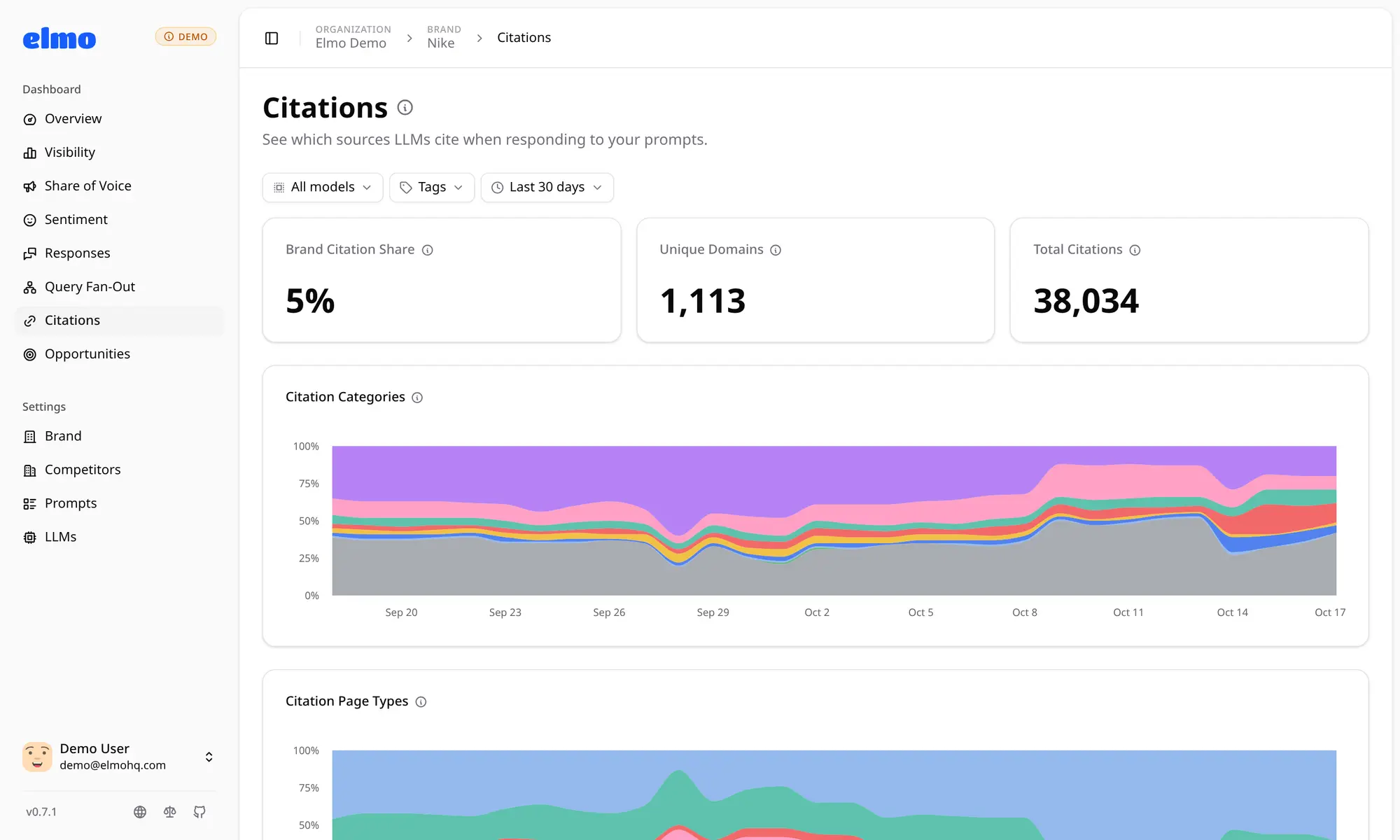
- Find the pages AI trusts See every website AI answers cite, grouped by domain and type, so you know where you need to be mentioned.
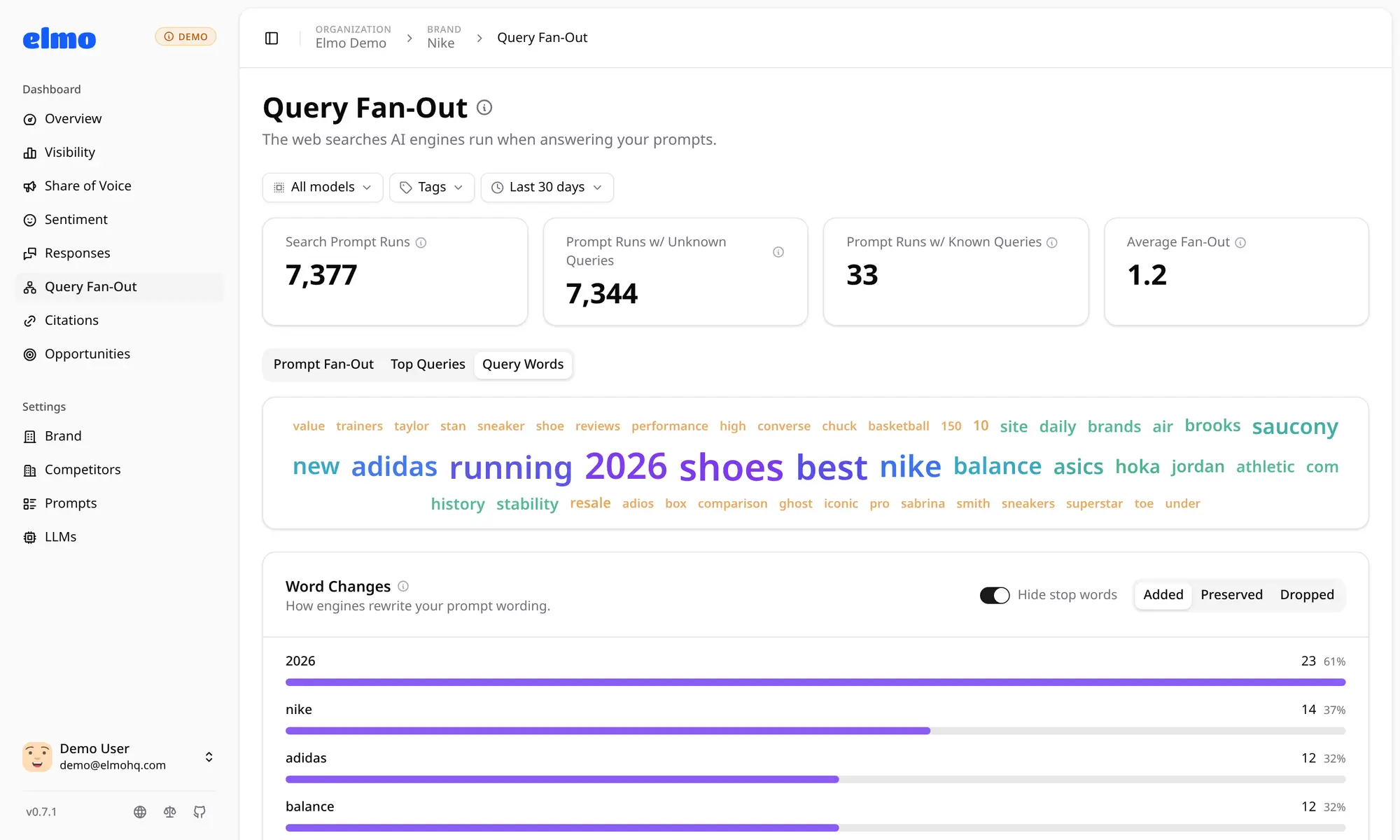
- See what AI searches for Query fan-out shows the web searches an AI ran before answering and how it reworded your question.
- Get a list of next steps The Opportunities report suggests what to write, pitch and publish to be cited more often.
- Start from your website A setup wizard suggests questions, competitors and customer types from your website, and you can add your own.
- Share reports and connect tools Send report links people can open without an account, or read the data from your own tools and AI assistants.
Replaces Profound, Peec AI and Otterly.AI
Elmo does the same job as Profound, Peec AI and Otterly.AI. Here is what changes when you switch.
- No subscription for Elmo itself, with no limit on brands or questions
- Every AI answer is kept on your server, so you can check how each number was worked out
- You choose which AI engines to track and how often
- Your brand, competitors and answers stay in your own database
- You pay an AI provider for every check, and scraping the real ChatGPT and Google AI Mode needs a separate scraping service
- You set up the AI-provider accounts yourself instead of getting one bill
- Microsoft Copilot and the Perplexity app can't be checked directly, only through Bing's AI answers and Perplexity's own model
- Your history in Profound, Peec AI or Otterly.AI does not move across
What happens when you click Deploy?
You do not need a server or any technical knowledge. Four steps, and Elmo is running at its own web address.
- Step 1 Click Deploy and create your account
Deploy takes you to Cloudgate. Create an account, or log in if you have one. Elmo itself is free.
- Step 2 Choose a server
No server? Get one from Cloudgate: pick a size and a country, and Cloudgate gets it ready. Already have one? Connect it instead.
- Step 3 Cloudgate sets up Elmo
It prepares the server, makes the passwords the app needs and starts it. There is nothing to install and nothing to write down.
- Step 4 Open your app and sign in
Your app gets a free web address to start, without https. Add your own domain, like app.yourshop.com, and Cloudgate secures it with https for you.
New to Cloudgate? See what Cloudgate is
Run Cloudgate yourself? Deploy from your own console
In your Cloudgate console, open Templates and choose Elmo.
Questions
Is Elmo free?
Yes, Elmo is free and open source under the MIT licence, with no limit on brands or tracked questions when you host it yourself. Each check is sent to an AI provider or scraping service you sign up for, so tracking has a running cost that grows with how many questions you track and how often.
Is Elmo a good alternative to Profound or Peec AI?
Yes, if you want the core AI visibility numbers (mentions, share of voice, sentiment, position and citations) without a monthly subscription. You connect and pay the AI providers yourself, and Elmo does not offer the managed service or Copilot app tracking some paid tools include.
What do I need besides a server to run Elmo?
You need at least one AI-provider API key. A single OpenRouter key is enough to start, because it covers the model that reads each answer, the setup wizard and checks through models such as Claude and Perplexity's Sonar. Cloudgate asks for that key at setup. To see what the real ChatGPT, Google AI Mode and Gemini apps show, Elmo also needs a scraping service such as Cloro, BrightData or SearchApi: you add its key later as a variable on the app's page in Cloudgate, such as CLORO_API_KEY, and list it in SCRAPE_TARGETS.
Which AI assistants can Elmo track?
Elmo tracks ChatGPT, Google AI Mode, Google AI Overviews, Gemini, Bing's AI answers, Claude, Perplexity, Grok and other models. The real consumer apps are checked through a scraping service, and the rest through the AI companies' own APIs.
How do I sign in to Elmo the first time?
Open Elmo's web address, click Sign In, then Create an account and enter your name, email and a password. There is no default password; you are signed in straight away and can add your first brand. Only the first account can be created: sign-up closes after it, so one Elmo install has one account and no team invites.
What server size do I need for Elmo?
A small server with 1 GB of memory is enough. Elmo's web app, its background worker and its PostgreSQL database use about 450 MB together when idle, because the AI checks themselves run at the providers.
Is my data private when I host Elmo myself?
Yes, Elmo stores your brands, competitors, tracked questions and every AI answer in a database on your own server. The questions themselves are sent to the AI providers you choose, because that is how they get checked.
Do I need technical skills to run Elmo?
No. Click Deploy, create your Cloudgate account and choose a server, and Cloudgate sets up Elmo and gives it a web address. You use it in your browser like any other online tool.
Do I need my own server for Elmo?
No. When you deploy Elmo, hosted Cloudgate can provide a server. If you already rent one, you can connect it instead.
Can I move my data from Profound to Elmo?
Most people export from Profound and import into Elmo. The official guides at www.elmohq.com walk through it.
Related apps

Minimal, cookie-free visitor stats for all your websites.

Dashboards and a SQL editor on your own databases.

App analytics, crash reports and push in one place.

Dashboards and wall screens, built by drag and drop.