

Self-hosted alternatives to Resend

useSend is a free, open-source Resend alternative for sending your app’s emails through a REST API, SDKs or a dashboard, with an email log, delivery statistics and webhooks, plus marketing campaigns. Resend charges a subscription by plan; self-hosted useSend sends through your own Amazon SES account, so Amazon bills you for what you send, though it needs an AWS account and is still labelled beta.

2 alternatives Free apps Our pick: useSend

At a glance

App Good for Code Import from Resend Ease of use
useSend Small product teams sending app and marketing email through their own Amazon SES account Code Open source Import from Resend No Some setup
Reloop Product teams that want app email, campaigns and automations on a server they control Code Source-available Import from Resend Partly Some setup

Why look for an alternative to Resend?

Resend is a hosted email API for developers: apps send sign-up confirmations, receipts and other transactional emails through its API and code libraries, and a dashboard shows what happened to each one. It also sends broadcasts to audiences.

Developers look for an alternative because Resend is a subscription priced by plan, and because every email and its recipients pass through and are logged on Resend's platform. A self-hosted useSend gives you a similar API and dashboard on your own server, sending through your own Amazon SES account, so you pay Amazon for what you send rather than a monthly plan. Reloop, which is source-available, does the same from its own mail server instead of Amazon SES, and adds automations.

The alternatives, compared

useSend

Our pick

Email sending for your app and newsletters, on Amazon SES.

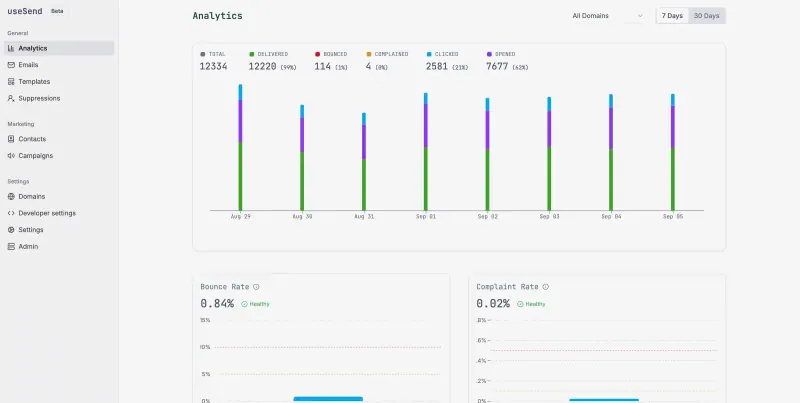
The closest open-source match for Resend: a REST API and code libraries for JavaScript, Python and Go, a dashboard with delivery statistics, a searchable email log, webhooks, a suppression list and several sending domains, plus campaigns to contact lists from a visual editor. It sends only through your own Amazon SES account, is still labelled beta, and this setup has no SMTP relay.

What you gain
  • A Resend-style dashboard and email API that you own
  • You pay Amazon per email sent, not a monthly plan or a fee per contact
  • App emails and marketing campaigns in one place
What is different
  • It only sends through Amazon SES, so you need an AWS account and must ask Amazon to lift the new-account sending limits
  • Sign-in is with GitHub or Google, not an email and password
  • It is still labelled beta, with fewer features than SendGrid, and no inbound email
Some setup Open source

An email API and campaigns, an alternative to Resend.

A Resend-style service with more built in: a REST API and code libraries for Node.js, Python, PHP, Ruby, Go and other languages, templates in a drag-and-drop editor or code, logs, metrics and signed webhooks, plus campaigns to contact groups and automations triggered by events in your app. It sends from its own mail server, so your server must be allowed to send on port 25, and this setup sends only through the API. It is source-available rather than open source, and heavier to run than useSend.

What you gain
  • App emails, campaigns and automations in one dashboard
  • No monthly plan or per-email fee from Reloop on your own server
  • Your email log and contact lists stay on your server
What is different
  • Your server must be allowed to send mail on port 25, which many cloud providers block, and your domain's reputation is yours to build
  • It is not a drop-in Resend API, so your app's sending code needs small changes
  • This setup sends only through the API and code libraries, and does not receive email or store uploaded images
Some setup Source-available

Moving from Resend

There is nothing to import from Resend, because the move is about where your app sends from. Set up Amazon SES first: create an AWS user with SES and SNS access and ask Amazon for production access so you can send to anyone. In useSend, add your sending domain and put its DKIM and SPF records in your DNS, then create an API key. Change your app to call useSend's API or code library instead of Resend's, send test emails, and watch bounces and complaints on the dashboard for a few days before you switch Resend off. Email history stays in Resend.

Reloop runs its own mail server, so first check that your server's provider allows outgoing mail on port 25, which many block until you ask, and set a reverse DNS record for the server. Create the admin account with the one-time setup key Cloudgate shows, add your sending domain and publish the DNS records the dashboard lists, then create an API key. Change your app's sending code from Resend's API to Reloop's, copy your HTML templates across, and import your contacts from a CSV file if you send broadcasts. Send test emails and watch bounces in the logs before you switch Resend off.

Questions

What is the best self-hosted alternative to Resend?

Start with useSend. Both are free to self-host. useSend is open source; Reloop (source-available) publishes its code under a licence with conditions an open-source licence does not have, such as limits on reselling it, keeping the maker's branding or a paid key for some features.

Is useSend's API the same as Resend's?

No, it is similar but not the same, so your app needs a small code change. useSend has its own REST API and code libraries for JavaScript, Python and Go, with sending, scheduling and webhooks for email events.

What does sending email with useSend cost?

useSend itself is free. Amazon bills your AWS account for each email sent through SES, and you pay for the server that runs useSend; there is no monthly sending plan.

Can I send newsletters from useSend too?

Yes. Besides app emails, useSend sends campaigns to contact lists, written in a visual editor, with double opt-in and one-click unsubscribe.

Should I choose useSend or Reloop?

Choose useSend if you already use Amazon SES or want the lighter, open-source app. Choose Reloop if you would rather send from your own mail server without an AWS account and want automations next to app emails and campaigns, and your server can send on port 25 and has at least 4 GB of memory.

Are these Resend alternatives really free?

useSend is free and open source; Amazon bills you for what you send through SES. Reloop is free to self-host for your own business, with no plan limits or metered sending, but it is source-available rather than open source: its licence forbids reselling it, offering it as a hosted service or using it in a competing product. To run them you need Cloudgate and a server: use hosted Cloudgate, which can also provide the server, or install Cloudgate on a server of your own for free. Cloudgate's plans and prices are at cloudgate.octabyte.io/pricing.

Do I need a developer to replace Resend?

Yes, for app emails. Cloudgate installs useSend, but someone has to create a GitHub app for sign-in and an AWS user with Amazon SES access before installing, then verify your sending domain and ask Amazon to lift the new-account sending limits. A developer then points your app at useSend's API or code libraries. Reloop needs no AWS or GitHub account, but someone has to make sure the server may send mail on port 25, add the DNS records for your sending domain, and point your app at Reloop's API or code libraries. Campaigns to contact lists are sent from the dashboard with no code in either app.