
C

Open-source alternatives to Canny

Fider is a free, open-source Canny alternative: a feedback board where people post ideas and feature requests, vote and comment, and follow each idea’s status on a roadmap. Canny’s free plan stops at 25 tracked users and its paid plans grow with the number of people giving feedback; self-hosted Fider has no user limit, though it has no changelog or built-in Jira and Linear sync.

2 alternatives Free apps Our pick: Fider

At a glance

App Good for Code Import from Canny Ease of use
Fider Small software teams who want a feature voting board with no per-user fee Code Open source Import from Canny No Some setup
Quackback Software teams who want a feedback board, roadmap and changelog in one app Code Open source Import from Canny Partly Easy

Why look for an alternative to Canny?

Canny is a hosted feedback tool for software companies. Users post feature requests and vote on them, the team shares a roadmap and a changelog, and integrations send ideas to tools such as Jira and Linear.

Teams look for an alternative because of how Canny charges. When we checked its pricing page in November 2026, the free plan allowed 25 tracked users and the Pro plan started at $79 a month billed yearly, with prices rising as more people take part. A popular board soon outgrows the free plan. A self-hosted Fider has no limit on users or ideas, includes moderation and search indexing at no extra cost, and keeps the feedback on your own server.

The alternatives, compared

Fider

Our pick

A self-hosted board where customers suggest and vote on features.

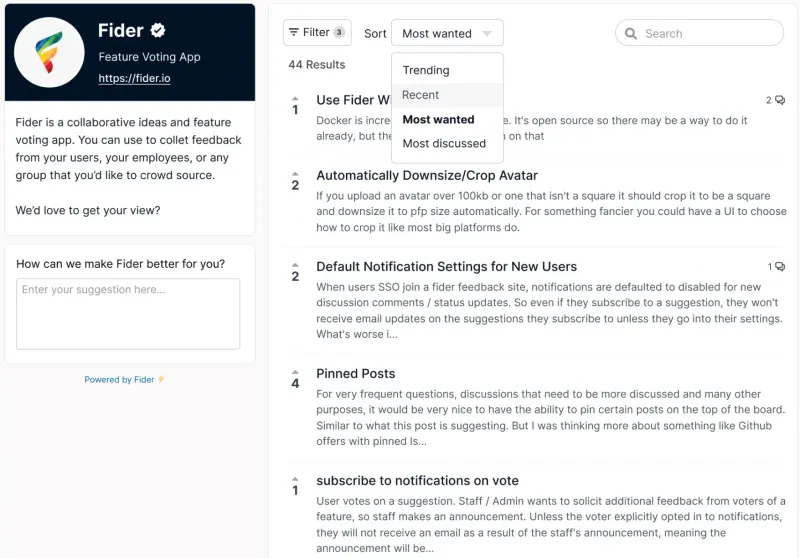
Covers Canny's core job: a public or private board where people post ideas, vote and comment, with statuses, a roadmap page, tags, moderation, your own logo and CSS, and no limit on users. Canny adds a changelog, user segmentation, revenue data and built-in Jira and Linear sync; Fider offers webhooks and an API instead, and runs one board per install.

What you gain
  • No limit on how many customers can post or vote, and no per-month fee
  • Moderation and search engine indexing are included, with nothing to unlock
  • Your customers' ideas and email addresses stay on your server
What is different
  • It needs an email sending service, even for you to sign in the first time
  • No changelog, customer segments or built-in Jira and Linear sync; webhooks and the API take their place
  • No widget to put inside your app; you link people to the board
Some setup Open source

Collect feature requests, share a roadmap, announce what shipped.

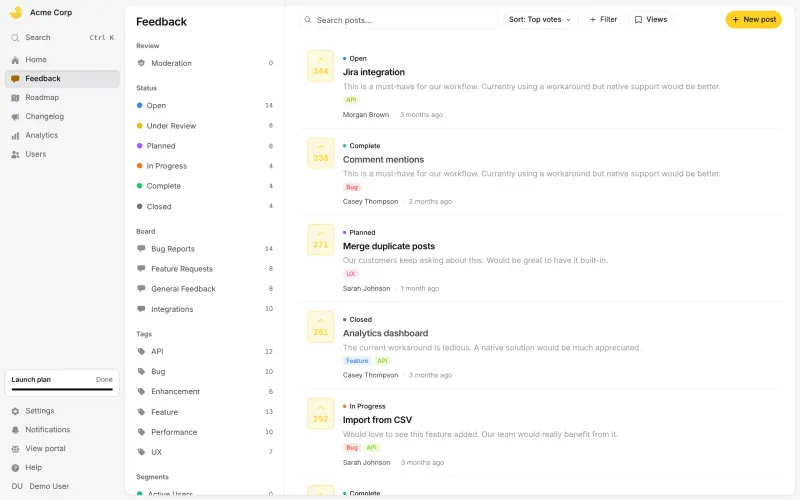
Covers Canny's board, voting, roadmap and changelog, and tells voters when their request ships. It adds two-way sync with Linear and GitHub, links to Jira and other trackers, several boards and roadmaps, and an optional help center and status page, with every feature and unlimited seats when self-hosted. It is a younger project that needs a bigger server, and it connects to fewer tools than Canny.

What you gain
  • Every feature is included, with no seat limit, no tracked-user fee and no licence key
  • Roadmap, changelog and Linear, GitHub and Jira links come with no paid plan to unlock
  • Your customers' ideas, votes and email addresses stay on your server
What is different
  • Moving from Canny is a CSV import that brings posts, statuses, tags and vote counts, but not who voted
  • Quackback is a young project that changes often, so back it up before each upgrade
  • It connects to fewer tools than Canny and has nothing like Canny's Autopilot
Easy Open source

Moving from Canny

Fider has no Canny importer. Set up an email service first, because Fider signs everyone in with an emailed link, then add your logo, tags and sign-in options. Bring across the ideas that are still open, starting with the most-voted, by posting them yourself or with a short script against Fider's REST API; votes and comments do not carry over, so note the old vote count in a post where it matters. Then swap the Canny links and widgets in your product for a link to the new board, and tell your users where to go.

Quackback can bring more across: export a CSV from Canny and map it onto Quackback's import template to bring posts, boards, statuses, tags and vote counts. Who voted and the comments need Quackback's API import script.

Questions

What is the best open-source alternative to Canny?

Start with Fider. If you want something simpler, try Quackback. Both are free and open source.

Can I import my Canny posts into Fider?

No. Fider has no Canny importer, so you post your open ideas again, by hand or through Fider's REST API. Votes and comments stay in Canny.

Does Fider connect to Jira, Linear or Slack?

Not directly. Fider sends webhooks when an idea is posted or changes status, which can post to Slack or Discord or start an automation, and its REST API lets you build a link to Jira or Linear.

Can a Fider board be private?

Yes. You can turn off public sign-ups and invite people instead, so only your customers or your staff can read and vote.

Which self-hosted Canny alternative has a changelog?

Quackback. Its changelog announces what shipped and notifies the people who voted for each request, and its roadmap can follow Linear and GitHub issues as they change.

Are these Canny alternatives really free?

Yes, Fider and Quackback are free. To run them you need Cloudgate and a server. Use hosted Cloudgate, which can also provide the server, or install Cloudgate on a server of your own for free. Cloudgate's plans and prices are at cloudgate.octabyte.io/pricing. One server can run several apps.

Do I need a developer to replace Canny?

No. Cloudgate installs the app you choose on your server and gives it a secure web address, and you use it in your browser instead of Canny.